

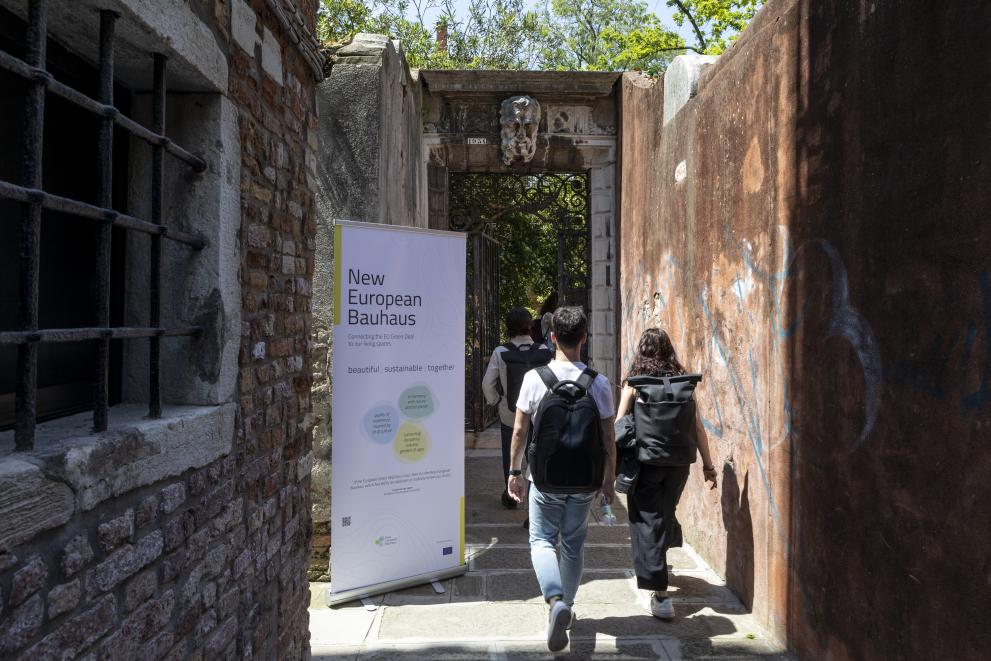
For the first time, the European Union participated with an event in the International Architecture Exhibition - La Biennale di Venezia on 25-26 May 2023. Following the central theme of the Biennale Architettura 2023, “Laboratory of the Future”, and in line with the objectives of the New European Bauhaus, the conference was designed as a radical, intellectual and practical laboratory of the future.
The event allowed experts, students, and visitors to experiment, discover and design the future with the power of their minds.
The participants reflected on radical, yet possible, human actions leading to a better use of space and resources. In particular, they discussed new ways of living, and how to go beyond the conviction that the future of the humankind is bound to already existing solutions.

DAY 1. 25 May
Activation of collective thinking
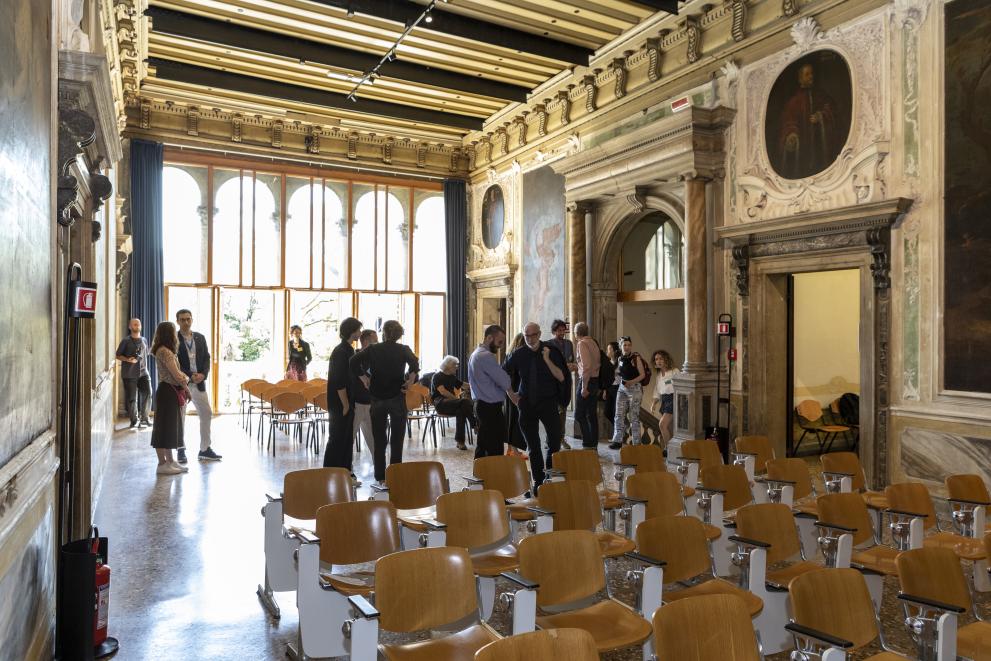
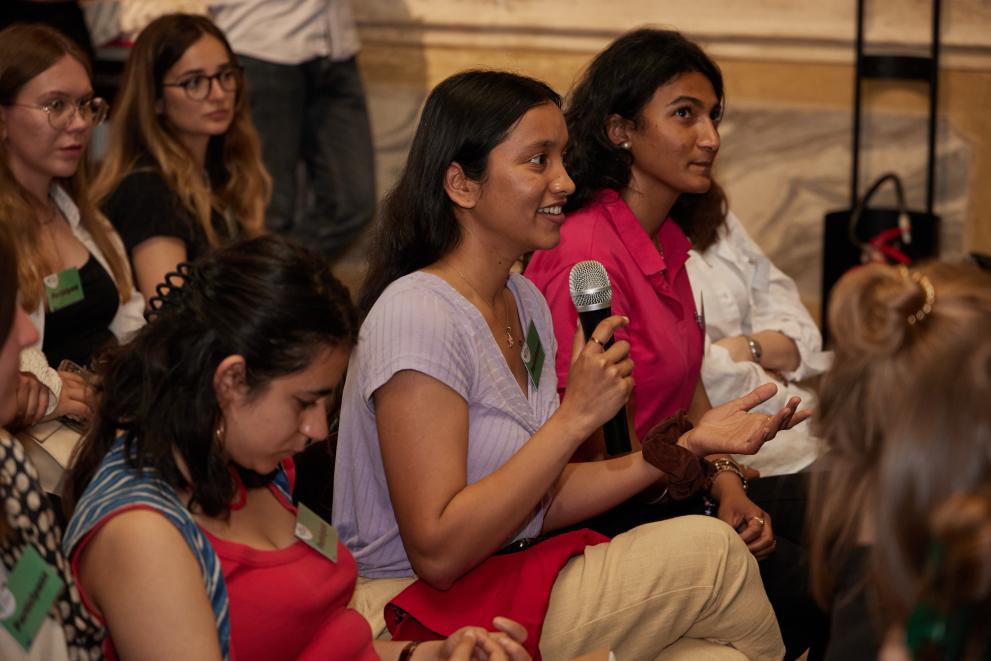
Six groups of experts and students joined parallel discussions in the “Radical NEB Labs” to work towards collective solutions for a sustainable, inclusive and beautiful future, understood as new ways of living, learning, designing, building, energy and material sourcing.
Location: Ca’Tron - IUAV
- 15.00 - 15.15
Introduction by Francesca Bria
- 15.15 - 16.15
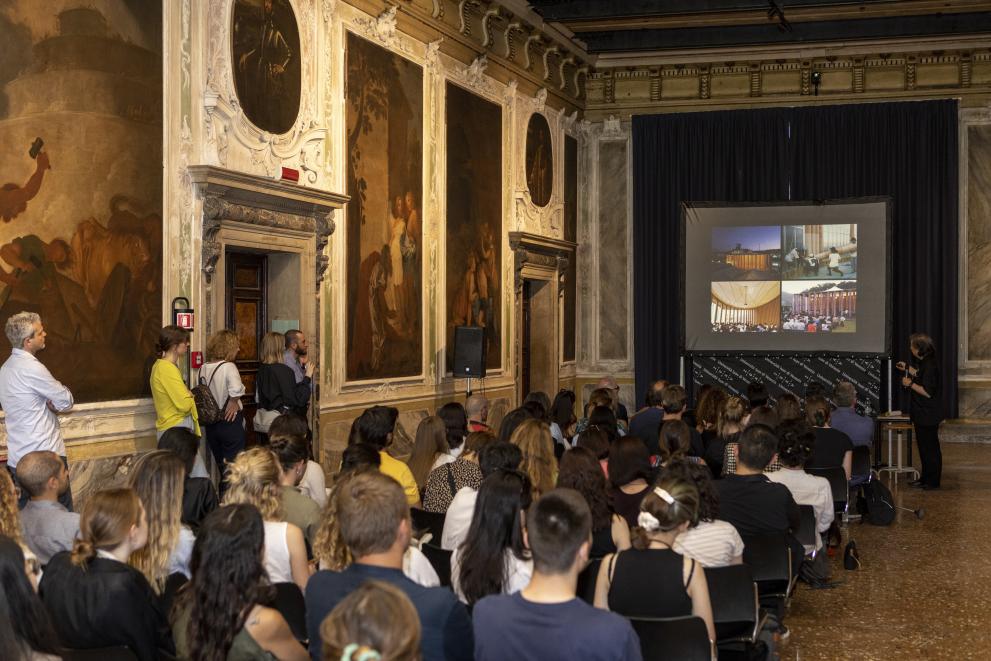
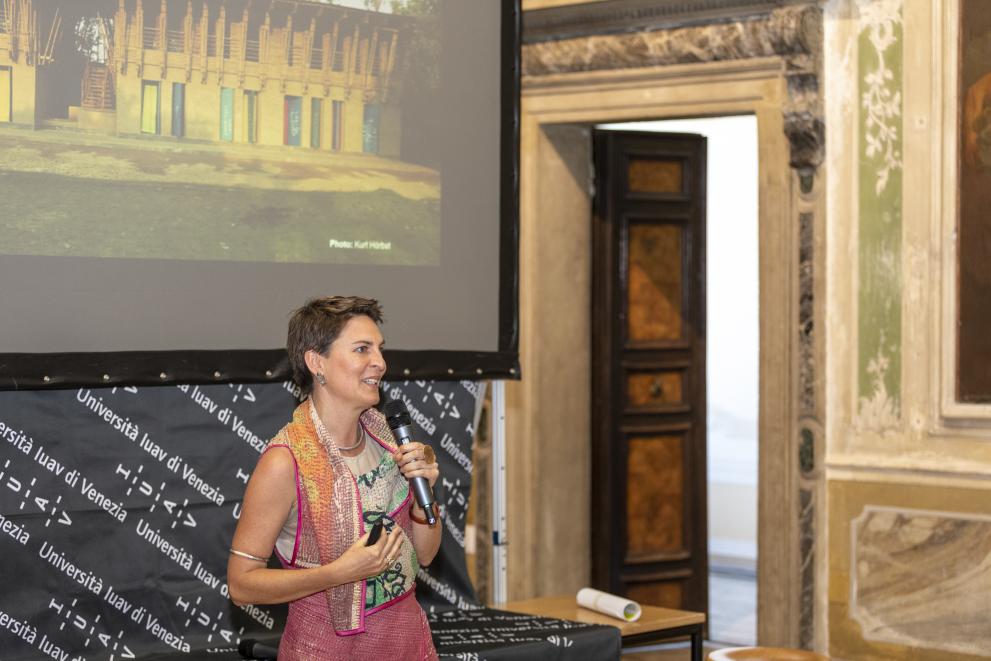
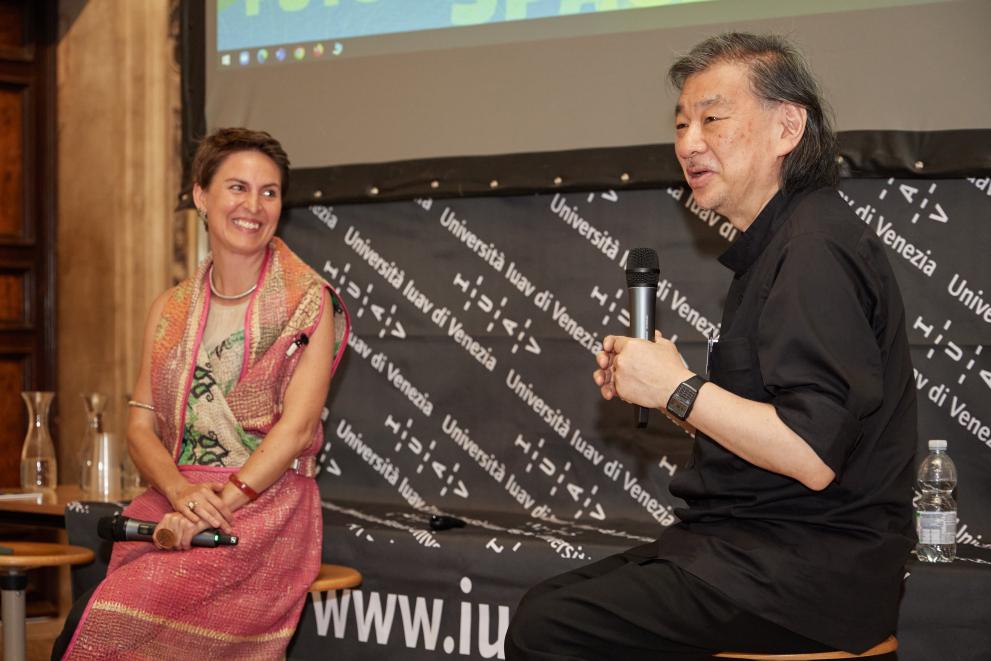
Masterclasses: Anna Heringer and Shigeru Ban
- 16.15 - 16.30
Introduction to the topics of the workshops by John Schellnhuber
- 16.30 - 18.00
6 parallel Radical NEB Labs
Lab 1. Dealing with future human behaviour - How will we learn?
Architecture and design are in a constant state of change and so is the learning and teaching. Especially now, (future) architects, designers and urbanists are facing a tsunami of new tasks related to disruptive challenges happening all at the same time. In addition, design is an applied science; therefore, the solutions to these challenges have to be tangible, feasible and appealing. Creation facing universal challenges can thrive only on the combination of formal and informal learning, theoretical and empirical knowledge and on swarm intelligence developed in a teamwork.
How can we learn (and teach) to strengthen unfolding of new visions and approaches to the future living spaces?
Speakers: Michela Magas - Thiemo Heilbron - Markus Reymann - John Gorman - Eva Franch I Gilabert
Working group: 20 students
Location: Ca’ Tron, room TBD
Lab 2. Dealing with future human behaviour - How will our needs, desires and values define the way we live and consume?
One of the greatest challenges for decarbonisation of our economy is changing individual behaviours. Household consumption accounts for more than half of all carbon emissions. So changing the way we consume — and what we consume — is going to be critical to getting to net zero and beyond it. From a political point of view, it is much easier to make sure that the supplier of energy, for example, produces less carbon dioxide. What we realise, though, is that in all of these efforts of getting to net zero by 2050, the technical solutions will not be enough. We will need to change our consumer behaviour and decarbonise our desires. We need to look at new models of economy, sharing and sufficiency to find new sources of satisfaction to replace the quantity of things with the quality of experience.
Could quality, beauty and sense of belonging be the answers to more satisfaction and decarbonisation of our lives?
Speakers: Alexandra Mitsotaki - José Luis de Vicente - Hilda Flavia Nakabuye - Clara Latini - Orla Murphy
Working group: 20 students
Location: Ca’ Tron, room TBD
Lab 3. Designing for possible futures - How will we build for resilience?
In its best form, architecture does not only build cities but also new perspectives, and hopes. A global building culture activated by a sense of social and environmental responsibility can transform the way we think about the future and show pathways for resilience. The New European Bauhaus offers a framework to co-shape and support this alternative building culture. What emerges when architects make use of techniques and materials at the crossroadbetween high-tech and low-tech, take inspiration from nature to incorporate mechanisms of adaptation and, often, accept not to build in favor of sharing and co-operation?
Speakers: Annette Hafner - Gaia Danese - Wael Al Awar - Xu Tiantian - Elisa Zatta - Sheela Patel
Working group: 20 students
Location: Ca’ Tron, room TBD
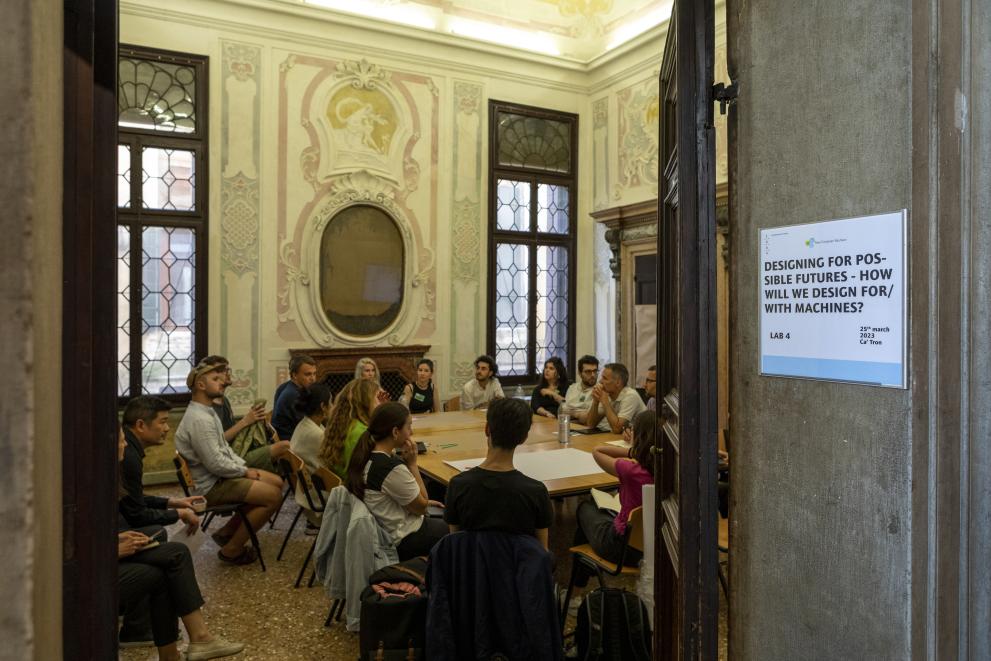
Lab 4. Designing for possible futures - How will we design for/with machines?
The power of Artificial Intelligence, increasingly accessible, is forcing us to address fundamental questions of authorship and creativity. At the same time, AI and other fast-evolving digital technologies call on creative minds to consider the architectural significance and design potential of new infrastructures for the non-human world. Data centres, which account for 4% of worldwide greenhouse emissions, are rapidly transforming our built environment. Can we imagine a design with and for machines that embraces ambitions of sustainability, beauty, and inclusion? How can we shape the future digital society in a humanistic way? How can digital tools (digital twins, AI) support the creation of more equitable and inclusive spatial models?
Speakers: Prodomos Tsiavos - Aric Chen - Eszter Dàvida - Petr Skvaril - Francesco Bergamo - José Pedro Sousa
Working group: 20 students
Location: Ca’ Tron, room TBD
Lab 5: Raising awareness of the Anthropocene - Venice at the forefront of the climate crisis
La Serenissima has a unique position on the world stage, but despite its perceived exceptionalism it faces the same risks as the Marshall Island, Tuvalu, New York city and other coastal sites that are threatened by the rising sea levels induced by anthropogenic climate change. Our Global Commons act upon all coastlines of the planet, yet neither are they represented at climate summits such as COP, nor have we developed a governance model that facilitates the consolidation, sharing and use of scientific data. The ambition of Lab 5 of the New European Bauhaus, is to mobilise the mediatic power of Venice and write – 60 years after the launch of the “Venice Charter” which regulated the conservation of the built environment – “The Venice Charter for our Global Commons”. Article One will explore the possibility of establishing dedicated transnational Data Centres and Data Spaces for our Global Commons.
The New European Bauhaus proposes a multi-level approach, trusting the potential of scaling and adapting local initiatives to other contexts and connecting different levels of governance, but how is it done concretely? How do we harness the power of examples, and how can we connect people dealing with similar problems to maximize the chances of success?
Speakers: Giulia Foscari - Markus Reymann - Hubert Trammer - Stephan Petermann - Mattia Bertin - Edgar Pieterse
Working group: 20 students
Location: Ca’ Tron, room TBD
Lab 6: Raising awareness of the Anthropocene – vulnerability and power of Beauty
Art and culture have always played a crucial role in human evolution. They are vital parts of our everyday life, and they are able to appeal to our senses, our emotions through their inspiring, engaging approach (conceptually, physically, and emotionally). At the same time, art and culture have the power to make us reflect on our being and our past, present and future
“Beauty” is also what makes the NEB different from other similar projects, and it has the potential to deeply impact people’s lives and, doing so, to transform the initiative into a real movement. But how? What are the crucial areas and where can we start to move the aesthetics debate decisively forward?
Speakers: Luther Quenum - Christoph de Jaeger - Benedetta Tagliabue - Gerfried Stocker - Federica Rossi - Pia Maier Schriever
Working group: 20 students
Location: Ca’ Tron, room TBD
Location: Palazzo Tolentini - IUAV
- 11.00 - 11.10
Welcome by the Mayor of Venice, Luigi Brugnaro (TBC)
Welcome by the rector of the university IUAV, Benno Albrecht
- 11.10 – 11.30
Opening speech by the President von der Leyen
- 11.30– 12.00
Dialogue between President von der Leyen and Professor Lesley Lokko
- 12.00 – 13.00Panel 1
Introduction by the reporters of the Lab 1 and Lab 2, Eva Franch i Gilabert and Orla Murphy
Speakers: José Luis de Vicente, Michael John Gorman, Clara Latini, Markus Reymann. Facilitator: Michela Magas
Panel 1: NEB as a catalyst of new mind-sets to support the goals of the Green Deal.
- 14.30 - 14.45
Curators Speeches: Wael Al Awar, Francesca Bria, John Schellnhuber
- 14.45 - 15.45Panel 2
Introduction by the reporters of the Lab 3 and Lab 4, Sheela Patel and Jose Pedro Sousa
Speakers: JoséPedro Sousa, Xu Tiantian, Gerfried Stocker, Aric Chen. Facilitator: Sheela Patel
Panel 2: Emergent architectures for climate justice and an inclusive digital future.
- 15.45 – 16.45Panel 3
Introduction by the reporters of the Lab 5 and Lab 6, Giulia Foscari and Pia Maier Schriever to the Panel 3
Speakers: Giulia Foscari, Edgar Peterse, Benno Albrecht, Carlo Barbante. Facilitator: Pia Maier Schriever
Panel 3: The global commons and climate change: Venice reporting from the front.
- 16.45 – 17.00
Conclusions
by the curators, Wael Al Awar, Francesca Bria, John Schellnhuber - 17.00 – 17.15
Closing speech by Commissioner Elisa Ferreira
- 17.15
Aperitivo
Venue
The two-day Collateral Event was organised by the New European Bauhaus in cooperation with Università Iuav di Venezia (IUAV).
Day 1: Ca’ Tron, Santa Croce 1957
Day 2: Aula Magna Tolentini, Santa Croce 191
