

“The best affordable housing does not look affordable,” Veronika Valk-Siska, head of housing policy at the Estonian Ministry of Climate, told the Festival audience. “It looks like a place where people are proud to be and to call a home. Heritage buildings often anchor communities,” she added.
"What I see happening in Estonia is that heritage conversion achieves this by default. So, place identity matters.”
Valk-Siska, who is also currently serving as a National Contact Point for New European Bauhaus projects in Estonia, cited the example of Põhjala tehas. This former rubber and metal works in the Estonian capital Tallinn was turned into a 100,000-square-metre mixed-use development.
She said the redevelopment used 60% less embodied carbon than an equivalent new construction would have done.
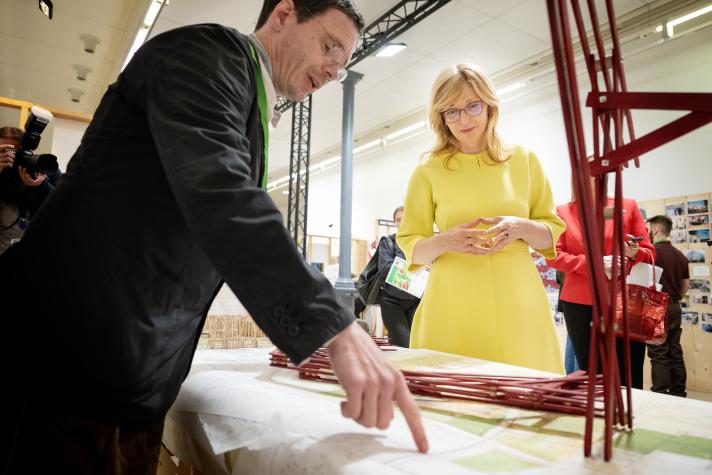
“The New European Bauhaus gives us a shared framework for shaping this transformation together, sustainably, inclusively and beautifully,” said Ekaterina Zaharieva, European Commissioner for Startups, Research and Innovation.
Two-fifths of Europeans say the lack of affordable housing is an immediate and urgent problem in the place where they live, rising to more than half for those living in cities, according to a 2025 Eurobarometer poll by the European Commission.
At the same time, construction has a significant impact on greenhouse gas emissions, with cement-making alone contributing around 4% of the EU’s emissions.
Early involvement
One way to encourage the renovation of industrial or other heritage buildings is for local authorities and landlords to bring in specialists to consider all the options before deciding to demolish, according to Eva De Bruyn, an architect and partner at design consultancy 51N4E.
“What we need is actually to involve architects, engineers, designers much earlier in the process, instead of only at the end,” she told conference attendees.
Conference participants heard that this approach is a central part of the NEB movement, in which citizens, experts, businesses, and institutions come together to create urban development projects that blend circular and clean technologies. This creates living spaces that are affordable and accessible, while being close to artistic and community activities.
“By putting people and communities at the centre of housing policies, and by encouraging innovation in the construction sector, the New European Bauhaus can help us build homes that are sustainable and genuinely liveable," said Dan Jørgensen, European Commissioner for Energy and Housing.
Because of the impact the NEB can have on creating sustainable affordable housing in this way, MEP Christian Ehler, who is on the Parliament’s Committee on Industry, Research and Energy, said the Parliament wanted to see money spent on housing taking account of NEB criteria.
“The Parliament is willing to mainstream the New European Bauhaus along the spending schemes of the European budget” he said during a speech at the Festival.
“Wherever we place housing in the next European budget, we want to see the money spent on housing alongside the criteria of the New European Bauhaus,” he added. “That would give it a completely new dimension.”
The Festival comes a few months ahead of European Commission adoption of the Circular Economy Act, which aims to increase the supply of recycled materials and make the EU the world leader in the circular economy by 2030.
The Commission argues that repurposing and reusing Europe’s empty buildings is essential if Europe is to achieve its aim of becoming more sustainable, especially as the construction sector is a significant emitter of greenhouse gases.
Festival of the New European Bauhaus
The third Festival of the New European Bauhaus, taking place from June 9 to 13 at Parc du Cinquantenaire in Brussels, follows a Commission plan to scale up the NEB as part of the European Affordable Housing package, presented in December 2025. The Council of the EU last month also urged countries to integrate NEB values into their national policies.
Almost €1.4 billion has been allocated to the New European Bauhaus since it was launched in 2020, with most of the funding coming from cohesion policy and the Horizon Europe programme.
The movement is entering a scale-up phase, with innovations taken from design to implementation now ready to be rolled out across Europe. This should create opportunities for investors and SMEs and contribute to strengthening Europe’s competitive edge as a world leader in circular and bio-based solutions.
- Publication date
- 11 June 2026
- Author
- Joint Research Centre